Wednesday, January 31, 2007

9/11, in perspective

So why has there been such an overreaction [to 9/11]? Unfortunately, the commentators who detect one have generally explained it in a tired, predictably ideological way: calling the United States a uniquely paranoid aggressor that always overreacts to provocation.


And maybe the reason for that is that the US has not in contemporary times (with contemporary weapons) had a war fought on its shores, and so its citizens are probably insulated from just how terrible war is.

Anyway, read the rest of the article. It's quite insightful.

Sunday, January 28, 2007

Helping my students find their voice.

I altered my teaching style a little this semester. In the past, I would go through a series of straight lectures on the topic at hand, with only a few short interruptions to Socratically discuss the more complex parts of the text, and then I would just wait until the end of the lectures on each text to engage in a more free-flowing discussion of the students' reactions to the text we were reading.

This semester, however, I decided to incorporate the free-flowing discussions in every session. Every class I introduce at least one provocative question related to the topic that I get my students to discuss, and allow the discussion to go where it may. The only exception to my discussion-in-every-class rule is when we're running late in our itinerary and have to finish our topic quickly; but even during those times, I give my students a story or an insight which is provocative enough to get them thinking.

I'm not sure if it's a mere coincidence, but it seems that this pedagogical method has been helpful for my students. They recently accomplished their first essay for the semester, and most of the essays reveal that my students have developed a sense of confidence in their own voices, a willingness to go beyond the texts to explain their own thoughts. In comparison, my students in the past semesters were much more timid, much more liable to stick to the text or to what I said in class (sometimes almost verbatim).

Sunday, January 21, 2007

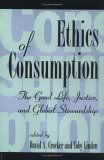
Ethics of Consumption

This weekend, I started trying to eliminate my backlog of unread books. Last night I began reading Ethics of Consumption a compilation of scholarly article on, well, the ethics of consumption by ethicists, philosophers, economists, and social scientists.


Two possible projects:

======

(1) I'm not sure if any research has been done in the Philippines regarding ethical views towards buying among consumers. If there is no such research, I would like to undertake it, although of course I'd need to learn how to undertake an empirical study. (I did a course on Experimental Psychology in college, so I do have a teeny bit of background, but of course it isn't enough.)

======

(2) Another interesting point in the book is the reflection on what can be considered "sufficient" for a person. In my undergraduate Theology of Liberation class, we were introduced to the notion that a person is "poor" when he is a "non-person," implying not only an economic state but also a sociological state where a person lives without dignity.

On both the economic and sociological counts, this is a muddled definition. What we in the contemporary age would consider to be "necessary for survival" is different form what people would consider to be such 500 years ago.

Even more complex is the question of what is it to live "with dignity." Other scholarly articles also allude to sociological measures such as "happiness" or self-perceptions of poverty. One of the articles I was reading in the book suggested, however, that, as one might expect, one's perception of how poor one is has more to do with one's relative standing in society, or how one is treated in society, than one's absolute income or economic state.

If that is the case, then it would seem that at least one aspect of "poverty" is not so much a question of income but a question of how people ought to be treating one another.

Saturday, January 06, 2007

The Dawn of the New Age of the American Empire, for real?

I used to regard the phrase "American Imperialism" as an anachronistic historical concept, as a hyperbolic description of the dominance of U.S. popular culture around the world, or as Philippine leftist rhetoric.

But just today, I have read allusions to a new American empire twice, both from North Americans.

This morning I read a few chapters of Why Nations Go To War, a book my mom got from her college and which she left here in the Philippines for me to read, the last time she was here. The author is John G. Stoessinger, Ph.D. (Harvard), "Distinguished Professor of Global Diplomacy" at the University of San Diego.

... the United States, for the first time in its history, fought a war of choice, not of necessity. By going to war in March 2003, it put into action a doctirine of preempting in order to remove a dictator and to attempt to turn his county into a democracy. By doing so, the American republic took a first step toward becoming an imperial power.

Top officials in the Bush administration actually convened a seminar on June 16, 2003, on the subject of "Rules and Tools for Running an Empire." [323-328]


Then, while doing my daily skimming of articles indexed on Arts and Letters Daily, I read Colby Cosh's column, "Does America Need a Foreign Legion?" The column begins its argument for an American foreign legion with the observation that "today little energy remains behind U.S. resistance to the imperial temptation. President Bush's 2000 electoral promise to pursue a 'humble' foreign policy has become a joke. Sept. 11 proved it is no longer in his power, or anyone else's."

Ugh.

Tuesday, January 02, 2007

Christus Apollo

Some of my students laughed when I mentioned once in class that Christology has to contend with the question of life on other planets. Today I found this, by Ray Bradbury. Bless his soul. What a wonderful image of Christ.

Happy New Year. And in advance, happy Feast of the Epiphany!

=============

christus apollo
by Ray Bradbury

cantata celebrating the eighth day

of creation and the promise

of the ninth


A Voice spoke in the dark,
And there was Light.
And summoned up by Light upon the Earth
The creatures swam
And moved unto the land
And lived in garden wilderness;
All this, we know.
The Seven Days are written in our blood
With hand of Fire.
And now we children of the seven eternal days
Inheritors of this, the Eighth Day of God,
The long Eighth Day of Man,
Stand upright in a weather of Time
In downfell snow
And hear the birds of morning
And much want wings
And look upon the beckonings of stars,
And need their fire.
In this time of Christmas,
We celebrate the Eighth Day of Man,
The Eighth Day of God,
Two billion years unending
From the first sunrise on Earth
To the last sunrise at our Going Away.
And the Ninth Day of the History of God
And the flesh of God which names itself Man
Will be spent on wings of fire
Claimed from sun and far burnings of sun starlight.
And the Ninth Day’s sunrise
Will show us forth in light and wild surmise
Upon an even further shore.
We seek new Gardens there to know ourselves.
We seek new Wilderness,
And send us forth in wandering search.
Apollo’s missions move, and Christus seek,
And wonder as we look among the stars
Did He know these?
In some far universal Deep
Did He tread Space
And visit worlds beyond our blood-warm dreaming?
Did He come down on lonely shore by sea
Not unlike Galilee
And are there Mangers on far worlds that knew His light?
And Virgins?
Sweet Pronouncements?
Annunciations? Visitations from angelic hosts?
And, shivering vast light among ten billion lights,
Was there some Star much like the star at Bethlehem
That struck the sight with awe and revelation
Upon a cold and most strange morn?
On worlds gone wandering and lost from this
Did Wise Men gather in the dawn
In cloudy steams of Beast
Within a place of straw now quickened to a Shrine
To look upon a stranger Child than ours?
How many stars of Bethlehem burnt bright
Beyond Orion or Centauri’s blinding arc?
How many miracles of birth all innocent
Have blessed those worlds?
Does Herod tremble there
In dread facsimile of our dark and murderous King?
Does that mad keeper of an unimaginable realm
Send stranger soldiers forth
To slaughter down the Innocents
Of lands beyond the Horsehead Nebula?
It must be so.
For in this time of Christmas
In the long Day totalling up to Eight,
We see the light, we know the dark;
And creatures lifted, born, thrust free of so much night
No matter what the world or time or circumstance
Must love the light,
So, children of all lost unnumbered suns
Must fear the dark
Which mingles in a shadowing-forth on air.
And swarms the blood.
No matter what the color, shape, or size
Of beings who keep souls like breathing coals
In long midnights,
They must need saving of themselves.
So on far worlds in snowfalls deep and clear
Imagine how the rounding out of some dark year
Might celebrate with birthing one miraculous child!
A child?
Born in Andromeda’s out-swept mysteries?
Then count its hands, its fingers,
Eyes, and most incredible holy limbs!
The sum of each?
No matter. Cease.
Let Child be fire as blue as water under Moon.
Let Child sport free in tides with human-seeming fish.
Let ink of octopi inhabit blood
Let skin take acid rains of chemistry
All falling down in nightmare storms of cleansing burn.
Christ wanders in the Universe
A flesh of stars,
He takes on creature shapes
To suit the mildest elements,
He dresses him in flesh beyond our ken.
There He walks, glides, flies, shambling of strangeness.
Here He walks Men.
Among the ten trillion beams
A billion Bible scrolls are scored
In hieroglyphs among God’s amplitudes of worlds;
In alphabet multitudinous
Tongues which are not quite tongues
Sigh, sibilate, wonder, cry:
As Christ comes manifest from a thunder-crimsoned sky.
He walks upon the molecules of seas
All boiling stews of beast
All maddened broth and brew and rising up of yeast.
There Christ by many names is known.
We call him thus.
They call him otherwise.
His name on any mouth would be a sweet surprise.
He comes with gifts for all,
Here: wine and bread.
There: nameless foods
At breakfasts where the morsels fall from stars
And Last Suppers are doled forth with stuff of dreams.
So sit they there in times before the Man is crucified.
Here He has long been dead.
There He has not yet died.
Yet, still unsure, and all being doubt,
Much frightened man on Earth does cast about
And clothe himself in steel
And borrow fire
And himself in the great glass of the careless Void admire.
Man builds him rockets
And on thunder strides
In humble goings-forth
And most understandable prides.
Fearing that all else slumbers,
That ten billion worlds lie still,
We, grateful for the Prize and benefit of life,
Go to offer bread and harvest wine;
The blood and flesh of Him we Will
To other stars and worlds about those stars.
We cargo holy flesh
On stranger visitations,
Send forth angelic hosts,
To farflung worlds
To tell our walking on the waters of deep Space,
Arrivals, swift departures
Of most miraculous man
Who, God fuse-locked in every cell
Beats holy blood
And treads the tidal flood
And ocean shore of Universe,
A miracle of fish
We father, gather, build and strew
In metals to the winds
That circle Earth and wander Night beyond all Nights.
We soar, all arch-angelic, fire-sustained
In vast cathedral, aery apse, in domeless vault
Of constellations all blind dazzlement.
Christ is not dead
Nor does God sleep
While waking Man
Goes striding on the Deep
To birth ourselves anew
And love rebirth
From fear of straying long
On outworn Earth.
One harvest in, we broadcast seed for further reaping.
Thus ending Death
And Night,
And Time’s demise,
And senseless weeping.
We seek for mangers in the Pleides
Where man the god-fleshed wandering babe
May lay him down with such as these
Who once drew round and worshipped innocence.
New Mangers lie waiting!
New Wise men Descry
Our hosts of machineries
Which write immortal life
And sign it God!
Down, down Alien skies.
And flown and gone, arrived and bedded safe to sleep
Upon some winters morning deep
Ten billion years of light
From where we stand us now and sing,
There will be time to cry eternal gratitudes
Time to know and see and love the Gift of Life itself,
Always diminished,
Always restored,
Out of one hand and into the other
Of the Lord.
Then wake we in that far lost
Nightmare keep of Beast
And see our star recelebrated in an East
Beyond all Easts.
Beyond a snowdrift sifting down of stars.
In this time of Christmas
Think on that Morn ahead!
For this let all your fears, your cries,
Your tears, your blood and prayers be shed!
All numb and wild one day
You shall be reborn
And hear the Trump break forth from rocket-trembled air
All humbled, all shorn
Of pride, but free of despair.
Now listen! Now hear!
It is the Ninth Day’s morn!
Christ is risen!
God survives!
Gather, Universe!
Look, ye stars!
In the exultant countries of Space
In a sudden simple pasture
Far beyond Andromeda!
O Glory, Glory, a New Christmas
Torn
From the very pitch and rim of Death,
Snatched from his universal grip,
His teeth, his most cold breath!
Under a most strange sun
O Christ, O God,
O man breathed out of most incredible stuffs,
You are the Savior’s Savior,
God’s pulse and heart-companion,
You! The Host He lifts
On high to consecrate;
His dear need to know and touch and cry wonders
At Himself.
In this time of Christmas
Prepare
In this holy time
Know yourself most rare!
Beyond the vast Abyss
See those men grown Wise
Who gather with their gifts
Which are but Life!
And Life that knows no end.
Behold the rockets, more than chaff, on air,
All seed that save a holy seed
And cast it everywhere in mindless Dark.
In this time of Christmas
This holy time of Christmas,
Like Him, you are God’s son!
One Son? Many?
All are gathered now to One
And will wake cradled in Beast-summer breath
That warms the sleeping child to life eternal.
You must go there.
In the long winter of Space
And lie you down in grateful innocence
At last to sleep.
O New Christmas,
O God, far-motioning.
O Christ-of-many-fleshed made one,
Leave Earth!
God Himself cries out.
He Goes to Prepare the Way
For your rebirth
In a new time of Christmas,
A holy time of Christmas,
This New Time of Christmas,
From all this stay?
No, Man. You must not linger, wonder.
No, Christ. You must not pause.
Now.
Now.
It is the Time of Going Away.
Arise, and go.
Be born. Be born.
Welcome the morning of the Ninth Day.
It is the Time of Going away.
Praise God for this Annunciation!
Give praise,
Rejoice!
For the time of Christmas
And the Ninth Day,
Which is Forever’s Celebration!

Thursday, December 28, 2006

Edublogs

Wandered onto Edublogs.org today and it looks interesting. I like the fact that users get free Wikis as well.

I'm not entirely sure how I would use it, though. It appears that each user can only create one blog, so I wouldn't be able to create separate blogs for each class unless I had several usernames.

The Wiki is very promising, though. I may use it for my students' ALTP project next semester. Hmmm. I'll have to think about it some more.

Any suggestions? How might philosophy instructors use blogs and wikis?

Update, 2 January 2007: Today I found curriki.org through a link on Time.com.

Wednesday, December 27, 2006

Christmas holiday book purchase

We went to Fully Booked yesterday and Mike bought me this:


I'll let you know how it is.

Wednesday, December 13, 2006

Tuesday, December 05, 2006

The age of consent

This chart makes it appear that the Philippines has one of the lowest ages of sexual consent in the world. (This document places it at 18 but doesn't cite the law.)

It's a little more complex than that, though. There are various laws protecting persons under twelve and under eighteen from sexual abuse.

Let me preface all this by saying I'm no lawyer. Nonetheless, here's what I understand.

First, there is the law on statutory rape, which essentially says that any form of sex with anyone under the age of twelve is automatically a crime. The penalty is quite stiff in the Philippines: life imprisonment to death.

Secondly, sexual contact with anyone from twelve to seventeen for money or renumeration is also a crime.

Third, there is also a sexual harrassment law which criminalizes the requirement of sexual favors by a person in authority of his or her subordinate.

But what about consensual sex from ages to twelve to seventeen? Well here's where it appears to get more tricky. I haven't found any clear laws specifically pertaining to this, but the closest I could find was a law on seduction (click here then scroll down until you get to Michelle Basco's article).

According to this law, it is a crime to deceive (for example, with promises of marriage) or abuse one's authority, confidence, or relationship in order to gain the consent of a female (not male) to have sex, if she is: (a) from thirteen to seventeen-years-old, and (b) a virgin or a woman "of good reputation."

There does not seem to be any similar law for males nor for teenage women who are not "of good reputation."

If, then, this indeed is the only law directly pertaining to consensual sex involving teenagers from twelve to seventeen, I find it disturbing.

On the one hand, I know that the lack of legislation regarding this is partly cultural and historical. During my grandmothers' time, a lot of girls married in their early teens. Only in my lifetime was was the marrying age raised to eighteen (with parental consent, twenty-one with parental advice, twenty-five without parental consent nor advice).

Nonetheless, I think that there should be more protection for teenagers from being taken advantage of by adults, and I do think that there ought to be clearer laws in this regard.

First, I do think that the age of consent be raised. Another possibility would be to put some kind of "middle ground" put for statutory rape with a milder penalty, when, for example, the victim is between twelve and fourteen. (In some countries, for example, the penalty for this would be a minimum of ten years' imprisonment.)

Secondly, I've noticed that some countries have laws that adjust the penalty according to the age difference among the two parties. Perhaps something similar should be done in the Philippines. For example, maybe when the younger party is beyond the age of fourteen, the other person needn't be penalized if the age difference is five years or less, but perhaps there should be a penalty when the other person is more than five years older than the younger person. (I.e., it could be that consensual sex between a fourteen-year-old and a seventeen-year-old would not be criminalized, but consensual sex between a fourteen-year-old and a twenty-one-year-old would.)

===========

Update: I mentioned my thoughts to a friend of mine who is studying law, and he disagrees with me.

Also, the idea of setting the age of consent at twelve actually comes from British Common Law, under which it became a criminal act to "ravish" a girl under the age of twelve.

Hmmm. I still think that the case of a fifty-year-old male who has consensual sex with a thirteen-year-old (whether male or female) should automatically be considered a criminal act, even if the sex was consensual. And the fact is, the current laws do not seem to cover such a case. If they really do love each other, they can wait until the younger person is a little older.

Interesting links

The assymetry of the universe

Review of a book on Mao Zedong

Review of a book on regional accents

The Laguna Copperplate Inscription" a 1100-year-old piece of copper that threatens to challenge much of what we have learned about pre-colonial Philippine history

China

In the past few years, discussions about China have primarily focused on its economic growth. Most have forgotten the China of 1989, of political repression, and the fight for political freedom.

This article argues, however, that the China that the world glimpsed at Tiananmen Square is still very much alive, though in a somewhat different form. No common cause binds together today's dissenters as it did at Tiananmen, but protest--against any kind of abuse, whether from the party, from company bosses--appears to have become a way of life for many Chinese, probably even moreso now then then, with the advent of new communications technologies that give citizens new channels to express their unrest.

Protests have not only become bigger in size; they are now more numerous. In 1994, there were 10,000 such “mass incidents”; by 2003 there were 58,000; in 2004 and 2005 there were 74,000 and 87,000 respectively. This is according to official statistics, which undoubtedly undercount. According to the legal activist Jerome Cohen, a truer figure for the last year may be 150,000.

Virtually every segment in society (except, of course, senior Communist leaders and wealthy entrepreneurs) is participating in these public demonstrations. Almost anything, whether or not it is a genuine grievance, can trigger a sit-in, demonstration, or riot against party officials, village bosses, tax collectors, factory owners, or township cadres. Yet most observers still do not attach real significance to these protests—no doubt because, apart from a general desire for fair treatment, no common complaint or cause appears to bind them together.


Author Gordon Chang challenges the notion that economic stability can be a substitute for political freedom, even on the local or organizational level:

As Tocqueville observed, “steadily increasing prosperity” does not tranquilize citizens; on the contrary, it promotes “a spirit of unrest.” In pre-revolutionary France, discontent was highest in those areas that had seen the greatest improvement; the Revolution itself followed a period of unprecedented economic advance. In the late 20th century, the same trends played out in Thailand, in South Korea, and in Taiwan.

In China today, it is middle-class citizens, the beneficiaries of a quarter-century of economic reform, who are once again confirming the pattern. In Shanghai, homeowners recently fought a state-owned developer who had reneged on his agreement to keep an area of open land in the middle of a multi-building project; one group of residents tore down a fence to stop construction, and when the developer put up another, an even larger group demolished it. In Dongzhou in prosperous Guangdong province, riot police ended up killing perhaps as many as twenty people who were protesting the government’s arbitrary seizure of their land for a power project and denying them the use of a nearby lake.

This is not like Tiananmen. In 1989, Chinese protesters were peaceful until attacked. Those in Dongzhou, however, used pipe bombs as an initial tactic, to break up police formations. In present-day China, the well-to-do act like hooligans, and will even resort to deadly force, if that is what it takes to defend their rights.

Deng Xiaoping’s strategy after Tiananmen was to buy off the people by means of economic growth. It was successful, but only for a decade. Change begat the demand for more change. Grievances that were once tolerable began to appear intolerable when people realized they could be remedied. Since the end of the 1990’s, the laobaixing are no longer, to borrow one of Mao’s favorite phrases, “poor and blank.”

Sunday, December 03, 2006

The "original" Malays?

Interesting Wikipedia excerpt:

In the Philippines, many Filipinos consider the term "Malay" to refer to the indigenous population of the country as well as the population of neighboring countries like Indonesia and Malaysia. This misconception is due in part to American anthropologists H. Otley Beyer who proposed that the Filipinos were actually Malays who migrated from Malaysia and Indonesia. This idea was in turn propagated by Filipino historians and is still taught in schools. However, the prevalent consensus among contemporary anthropologists, archaeologists, and linguists actually proposes the reverse; namely that the Malays of Malaysia and Indonesia originally migrated south from the Philippines during the prehistoric period. Among these are scholars in the field of Austronesian studies such as Peter Bellwood, Robert Blust, Malcolm Ross, Andrew Pawley, and Lawrence Reid.


I don't know if this is true, but it's an interesting thought, isn't it?

Sunday, November 26, 2006

TM kooperatiba

I wasn't paying attention, but I caught a Touch Mobile TV commercial offering a special service for cooperatives. Sounds like an interesting concept.

Thanksgiving?

This different way of teaching Thanksgiving makes one wonder how a community's rituals ought to be taught.

Saturday, November 25, 2006

Fr. Danny's talk.

Fr. Danny Huang, SJ, the Philippine provincial of the Jesuits, gave the faculty a talk yesterday about what it means for Ateneo de Manila to be a Jesuit, Catholic university in this day and age.

As one could expect from Fr. Danny, it was a very good talk; the complexities were well-articulated and his ideas were nuanced and forceful.

First he emphasized that the Jesuit's educational apostolate is only one among its many apostolates.

Second, he talked about Paul's letter to Philemon and reflected about how that letter demonstrates how Christ had transformed the world in that Christ's message allowed for a new way of looking at property, at freedom, at social justice, at money, at persons.

The Church's mission is not expansion, he emphasized, but the redemption of history. It is (and this is my rephrasing) the creation of a new world order in every and all areas of human life, such that the world here may begin to look more like the Kingdom of God. In my own words again: the Church seeks not to increase in number, but to transform the world. (Something that one can only understand, I think, when one stops seeing the Church as "a denomination.")

In this sense, the Church sharply rejects the privatization of faith, the notion that faith is something that is articulated and experienced only in one's private life.

What, then, does it mean to be a Catholic university?

Again, my rephrasing: it is not merely a question of adding a Catholic element (such as theology classes or a campus ministry) to the work of a university, more than that and more importantly, it is to be a university in a way that is oriented to the redemption of history.

It is to form and educate the youth as mature Catholics or at least mature Christians or at least youths with a mature sense of the transcendent, young people, then, who emerge from university "with their hearts transformed and their freedom reoriented." It is to prepare our students as future professionals -- but to do this in a way that has been touched by the mission of building the Kingdom of God here on earth. In other words, it is to form students to be citizens and professionals for service and (if you prefer) nation-building. It is to do research that reflects on questions in light of God's mission to redeem history, drawing from the Catholic tradition of wisdom in an integrated and appropriate way. It is to be, as an institution, a witness to and advocate of the message of the Gospel in society and the world.

To be a Catholic university, then, does not make the university less of a university in the interest of becoming more Catholic. Moreover, being a Catholic university is not to become a monastery, or a seminary, or an NGO. (Again, the university is just one among the many apostolates of the Jesuits, and for that matter, just one sector in the entire world that the Church seeks to transform.)

To be a Catholic university is to be a university, a good university, an excellent university, in a thoroughly Catholic way. (My own reflection: in the same way that to be a Catholic person is to allow the Gospel to transform and reorient my entire human life, to be a Catholic university is to allow the Gospel to transform and reorient its being a university.)

Fr. Danny ended with some reflections on the realities within which the university must discern on the best way to proceed in this. Some of those realities including the diminishing number of Jesuits in the province, the increasing pluralism in society and among our students and faculty. Given this, the university must discern how to accomplish this task appropriately. Some of the questions raised in the open forum articulated this more specifically: the university must discern, for example, when it is best to explicitly label its work as "Catholic" and when it is appropriate to be more implicit; it must discern which practices and symbols to publicly express; it must discern how to dialogue with other faiths in a way that is true to its Catholicism yet also ecumenical and non-exclusive in spirit.

Truly, it was an excellent, thought-provoking talk.

Thursday, November 23, 2006

Sorry for the rant.

Newsweek featured a story last issue about the "veil debate" ongoing in Europe. One quote from Jack Straw bothered me. In stating his arguments against the face-covering Muslim veil, he said something about how people communicate with one another not only verbally but also visually: "You not only hear what people say, but you also see what they mean."

I have a huge problem with this argument. If you ask a Muslim woman to remove her veil because it is a visual meaning that you are uncomfortable with, at what point will it end? The long curls of an Orthodox Jewish rabbi have visual meaning too--is that what is next to go? The sari of an Indian woman is a visual meaning too--will you ask Indian women to change their dress? Or how about the turban of a Sikh man? What's next? The traditional garb of an Irish man? The same can be said even for the color of my hair, the color of my eyes, the color of my skin, the shape of my nose. When you see all those and know that I am, say, "Filipino," is that also not a "meaning" that you must learn to contend with? Are you next going to ask all ethnic minorities to bleach their skin, dye their hair, get noselifts to make their noses more Western?

What is the issue, really? Rectify the names. Is it really the veil? Or is it your discomfort at immigration? At the end of the day, you just don't like to be reminded that there are all these "different" people? Your imperial past is haunting you now.

Jack Straw said that the veil "separates people." By all means, if we truly believe in a multicultural society, then let us please, please be separated, by the diversity of our faiths, of our ethnicities, of our individual perspectives. This is the 21st century. Surely by now we should've learned to celebrate diversity. And then let us find unity within that diversity, not at its expense. Malaysia and Singapore might not yet have experienced perfect integration, but I do feel that their example is something the Western European countries can learn from.

In the past century, women have fought to wear trousers. People in colonized countries have fought to wear their traditional dress. Ironic that now, faithful Muslim women should have to fight for their right to wear a veil.

A just society is a society where, as Arendt said, we are both gathered and separated: separated by our individual views, where no single person is forced to be homogeneous with the other. And gathered by our common interests.

Some Arendtian critiques I'd like to work on.

Arendt's critique of Marx

... can be summed up in these two excerpts, one referring to the problem of labor, the other referring to the problem of history:

To put it another way: while others were concerned with this or that right of the laboring class, Marx already foresaw the time when, not this class, but the consciousness that corresponded to it, and to its importance for society as a whole, would decree that no one would have any rights, not even the right to stay alive, who was not a laborer. The result of this process of course has not been the elimination of all other occupations, but the reinterpretation of all human activities as laboring activities....

For Hegel, thinking historically, the meaning of a story can emerge only when it has come to an end. End and truth have become identical; truth appears when everything is at its end, which is to say when and only when the end is near can we learn the truth. In other words, we pay for truth with the living impulse that imbues an era, although of course not necessarily with our own lives.


-- from here.

It just occurred to me that anyone who quotes Marx but doesn't know Hegel, doesn't really know the full implications of Marx.

======

Arendt's view of 20th century totalitarianism

... as an evil that surpasses our traditional moral standards

The thread of our tradition, in the sense of a continuous history, broke only with the emergence of totalitarian institutions and policies that no longer could be comprehended through the categories of traditional thought. These unprecedented institutions and policies issued in crimes that cannot be judged by traditional moral standards, or punished within the existing legal framework of a civilization whose juridical cornerstone had been the command Thou shalt not kill.


I think that this element in Arendt may address what I perceive to be a weakness in Levinas. Levinas appears to place the locus of ethics only in the indvidual subject. However, if we admit to the possiblity of "structural sin," then is it not also possible to speak of a structural ethics? Levinas does not appear to address that.

Leninist Marxism tried to but ended up with a "structural ethics" that goes against the ethics of the individual subject.

We return again to Ricoeur's problem of the socius and the neighbor.

Professor Emeriti

Two of my teachers were conferred with the title of Professor Emeritus last night.

From one, I learned clarity--that the minute you find yourself obfuscating your ideas in highfalutin words, you are no longer thinking. He is also my model for equanimity, for patience with and respect for students, and for, despite his achievements and wisdom, always maintaining a humble sense of wonder at all things new.

Mula naman sa kabila, natutunan kong mag-isip nang tunay at buhay, at hindi lamang magsuka ng mga salita. Ginising niya ako sa kalaliman ng ating wika. At higit sa lahat, natutunan ko mula sa kanyang mga salita, buhay, at pagkatao, na maging mas mapagkumbabang mag-aaral ng pilosopo, mas mapagkalingang guro, mas mapagtiwalang Kristiyano, at mas mabuting tao.

Future reads.

Fareed Zakaria's book. I read his column weekly (and don't always agree with him). I wonder what he said in this book.

Something about Keynes.

Wednesday, November 22, 2006

Deng Xiaoping, Asian Filipino Values

A theme which was present in both my colleague's and my presentations at the last Colloquium was the notion of creating a social justice framework that springs from our own culture (rather than imposing foreign--whether capitalist or socialist--models that might be incompatible with our culture).

Tonight I was reading about Deng Xiaoping on Wikipedia, and I came across these paragraphs:
Unlike Hua Guofeng, Deng believed that no policy should be rejected out of hand simply for not having been associated with Mao, and unlike more conservative leaders such as Chen Yun, Deng did not object to policies on the grounds that they were similar to ones which were found in capitalist nations.

Although Deng provided the theoretical background and the political support to allow economic reform to occur, few of the economic reforms that Deng introduced were originated by Deng himself. Typically a reform would be introduced by local leaders, often in violation of central government directives. If successful and promising, these reforms would be adopted by larger and larger areas and ultimately introduced nationally. Many other reforms were influenced by the experiences of the East Asian Tigers.

For all of Deng's faults, his pragmatic way of approaching reforms--not immediately accepting or rejecting them simply because they fit or didn't fit the ideology--interests me.

The Arendtian in me finds that very practical. (For Arendt the fundamental error of the totalitarian governments was their insistence on forcing reality to fit the closed logic of their ideologies.)

Hmmm. While "Asian values" as defined by Lee Kwan Yew are actually Confucian values (and not Filipino values), I'm interested in how a debate on "Filipino values" in national economics would go.